
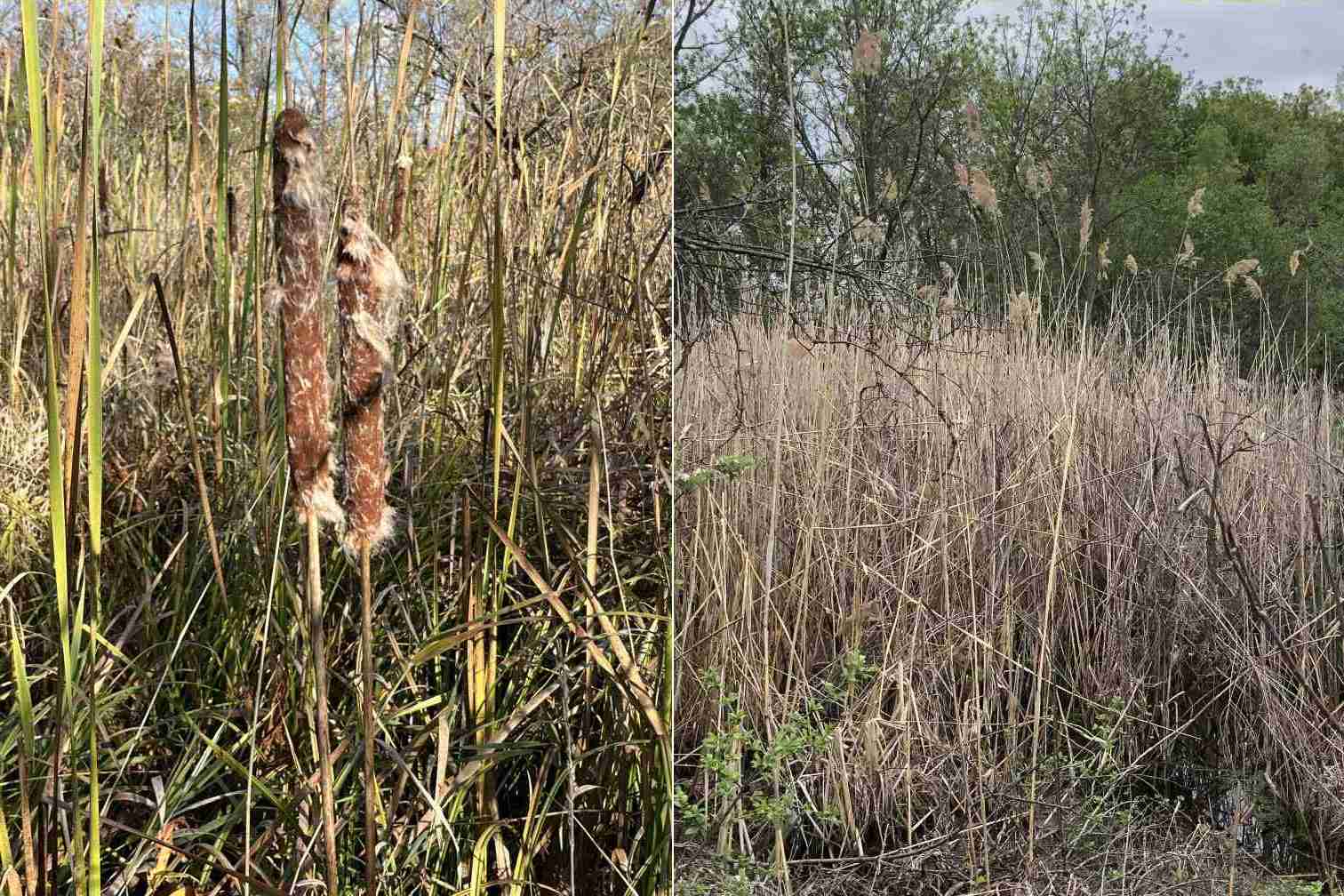
When I was growing up in the 50’s, 60’s and 70’s, in the ditches, streams or marshland one would see cattails. The brown top that looks like fuzzy hotdogs were commonplace. In the 80’s, I first noticed this grassy plant in the ditches, that I now know as phragmites.
Typha latifolia is commonly known as broadleaf cattails. Cattails are native to the wetlands of the Northern Hemisphere. Cattails are aquatic or semi-aquatic, rhizomatous, herbaceous perennial plants. Cattail stalks and rhizomes are edible and are known to have been eaten by ancient man. The seeds in the actual cattail are very very small and attached to fine hairs. When ripe, the heads disintegrate into a cottony fluff from which the seeds disperse by wind. The broadleaf cattails are important for maintaining wetland ecosystems and water quality. They provide critical habitat and resources for wildlife and humans. Broadleaf cattails provide shelter, nesting areas, and nurseries for many different species. Red-winged blackbirds weave nests in the leaves, fish and frogs use them for cover, and waterfowl nest in the vegetation. The plant is a source of food for many wetland animals. Muskrats, geese, and beavers eat the shoots and rhizomes, while finches and ducks eat the seeds. Narrowleaf cattail (typha angustifolia) is an invasive species to Michigan.
Phragmites australis also known as common reed, is one of the main wetland plant species used in settling ponds for phytoremediation water treatment (a method of using plants to clean up contaminated soil and water by absorbing or breaking down pollutants). Other variants of phragmites are used for thatched roofs, whole musical instruments and reed for instruments. The leaves, rhizomes, seeds and stems of phragmites are edible. Much of the phragmites can be ground into powder to be consumed. Phragmites can be grazed by domestic herbivores, such as sheep, goats, and cows that can effectively control the plant. Phragmites australis (haplotype M) is a non-native variant thought to be exotic or hybrid that can grow denser (up to 20 stalks per square foot) and taller (as tall as 15 feet).
Cattails and phragmites are similar weeds. Cattails are a native species whereas phragmites australis (haplotype M) is an invasive that can reduce native fish and wildlife populations, block out native vegetation like cattails and can be a fire danger.
Leave a Reply